
Identifying raspberry plants can be a challenge, especially for novice gardeners. With so many varieties to choose from, it’s easy to get confused about which one is growing in your backyard. Accurately identifying raspberry plants is essential if you want to control their spread, ensure they’re receiving the right care, and enjoy the delicious fruit they produce. In this article, we’ll explore the key physical characteristics, growth habits, and visual techniques to help you become a confident plant identifier. We’ll also cover the essential tools and tips you need to know, from leaf shape and color to stem length and canes’ orientation. By the end of this post, you’ll be equipped with the knowledge to confidently identify raspberry plants in your garden, allowing you to take control of their growth and harvest the rewards.
Understanding Raspberry Plant Identification
To identify a raspberry plant, it’s essential to examine its physical characteristics, including leaf shape, flower color, and canes. Let’s take a closer look at these distinguishing features together!
Physical Characteristics of Raspberries
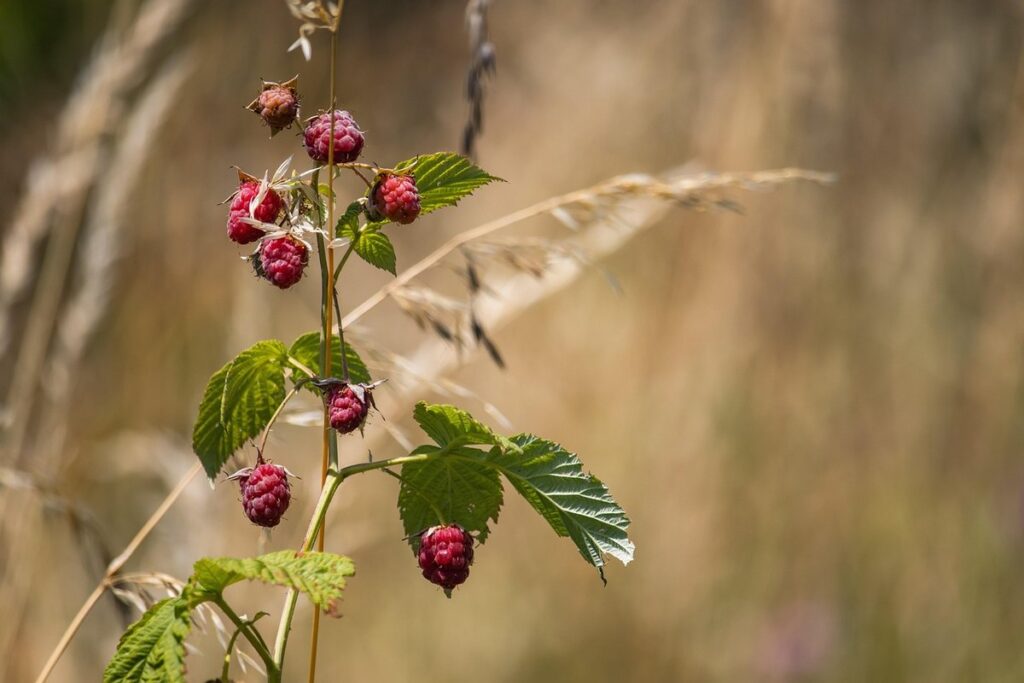
Raspberries are easily identifiable by their physical characteristics. The leaves of raspberry plants are typically trifoliate, meaning they have three leaflets that are arranged like a clover. These leaflets can be quite large and have a pointed tip. They usually range from light to dark green in color and may have a hairy texture.
The stems of raspberry plants, also known as canes, are another key identifier. Raspberries produce new growth each year, and these canes are typically long and thin with sharp thorns on the bottom half. The top half of the cane is usually smooth and slightly woody in texture. As the plant matures, the stems may become more woody and fibrous.
When it comes to growth habit, raspberries tend to grow upright or semi-erect, often reaching heights between 2-6 feet (60-180 cm). They can be trained onto supports or left to grow naturally on their own. Overall, taking note of the leaf shape, stem color, and growth habit will help you distinguish raspberry plants from other species.
Common Locations for Raspberries to Grow
Raspberry plants can be found growing in various locations around the world. In their native habitats, they often thrive in moist and temperate regions with well-drained soil. If you’re looking to identify raspberry plants in the wild or within your garden, here are some common locations to consider.
In North America, raspberries are commonly found along riverbanks, streams, and coastal areas where the soil is rich in nutrients. They often grow alongside other vegetation such as ferns, shrubs, and trees. In Europe, raspberries can be spotted in woodland edges, hedgerows, and along paths where they’ve been cultivated or have escaped from gardens.
When searching for raspberry plants, look for areas with acidic to neutral soil pH (around 6.0-7.0) and moderate moisture levels. Avoid areas with extreme weather conditions such as frost pockets or waterlogged soils that can lead to root rot. Some gardeners also cultivate raspberries in containers or raised beds to provide better control over growing conditions.
In forests, raspberry plants often grow in association with other bramble species like blackberry (Rubus fruticosus) and dog rose (Rosa canina). In these areas, they may form dense thickets that require careful identification.
Preparing for Identification
Before you head out to start looking at raspberry plants, it’s essential to understand what you’re trying to identify and gather some basic tools to aid in the process.
Essential Tools and Equipment Needed
To embark on identifying raspberry plants, it’s crucial to have the right tools and equipment by your side. You don’t necessarily need to break the bank, but investing in a few essential items will make the process smoother and more accurate.
Firstly, a good magnifying glass or hand lens is indispensable for getting up close with the plant’s details. These instruments allow you to examine the raspberry’s leaves, stems, and flowers with precision. For instance, the shape of the leaflets, the size of the stipules, and the arrangement of the inflorescence can all be observed clearly.
A reliable field guide is also vital for cross-referencing your observations with botanical descriptions. The Royal Horticultural Society’s ‘New RHS Dictionary of Gardening’ or Peter Redford’s ‘Raspberries and Blackberries’ are excellent resources to keep handy. While these tools may seem straightforward, it’s surprising how often they’re overlooked.
In addition to these must-haves, having a digital camera on hand can be beneficial for documenting the plant’s characteristics. This way, you can refer back to the images later and compare them with different species’ descriptions in your field guide.
Familiarizing Yourself with Raspberries’ Growth Cycle
To accurately identify a raspberry plant, it’s essential to understand its growth cycle. Raspberries are perennials that follow a distinct pattern of development, which can be divided into three primary stages: germination, vegetative growth, and fruiting.
Germination occurs when a dormant seed is exposed to favorable conditions, such as adequate moisture and temperature. This stage typically lasts 1-3 weeks, depending on the specific variety and environmental factors. As the seedling emerges, it develops its first set of leaves, which are usually heart-shaped or lobed.
During vegetative growth, the plant focuses on developing a robust root system and producing new canes (stems). This stage is crucial for establishing a healthy plant that will support future fruiting. Raspberries require a period of dormancy in winter to allow them to conserve energy and prepare for the next growing season. By understanding these key growth stages, you’ll be better equipped to identify raspberry plants at different times of the year and provide optimal care.
Visual Identification Techniques
To accurately identify a raspberry plant, you’ll need to examine its distinctive visual characteristics, including leaf shape and arrangement. This includes taking note of any thorns that may be present.
Leaf Structure and Arrangement
Raspberry leaves are a crucial identification feature for distinguishing raspberry plants from other canes. These leaves typically have 3-5 leaflets that are lance-shaped and pointed at the tip. The upper surface is usually dark green, while the underside may be lighter or have a bluish tint. Leaf size varies between species, but most raspberry leaves range from 2 to 4 inches (5-10 cm) in length.
The arrangement of leaves on the stem is another distinctive characteristic. Raspberry canes produce compound leaves, with the leaflets attached directly to the central rachis or stem. The leaflets are usually spaced evenly apart, creating a symmetrical appearance. When identifying raspberry plants, observe how the leaves fit into the leaf axil (the joint where the petiole meets the stem). In raspberries, the leaflet is often located just below the point where a lateral branch would emerge.
To verify your identification, inspect multiple leaves and stems, as the arrangement may vary. Observe the overall shape of the leaflets, their size, and coloration. Pay attention to any notable variations in leaf morphology that could indicate different species or cultivars within the raspberry family.
Stem Characteristics: Color, Diameter, and Texture
When inspecting raspberry plants, it’s essential to pay attention to their stem characteristics. This can be a crucial step in identification, as different species may have distinct features.
Raspberry stems are typically green, but they can also appear slightly brown or reddish depending on the age and condition of the plant. Young stems are often lighter in color than older ones, which tend to turn brown with exposure to the sun. In contrast, the stems of autumn-bearing raspberries tend to be more woody and fibrous.
The diameter of raspberry stems can also vary. Summer-bearing raspberry stems are usually around 3-4 mm thick, while autumn-bearing raspberry stems are thicker, typically between 5-7 mm in diameter.
The texture of the stem is another distinguishing feature. Raspberry stems are often slightly hairy or pubescent, especially towards the base. This characteristic can be more pronounced on younger plants.
When examining a plant’s stem, it’s also worth noting that cane identification can be an essential step in raspberry plant recognition.
Advanced Identification Methods
When it comes to confidently identifying raspberry plants, advanced methods can be a game-changer. Here we’ll explore some expert techniques for precise plant identification.
Using Flowers and Fruits for Identification
When it comes to identifying raspberry plants, flowers and fruits are some of the most obvious yet essential characteristics to examine. As you’re walking through a field or garden, take note of the type of flower clusters the plant produces. Raspberry plants typically produce solitary flowers that grow in the axils of the leaves, meaning they appear right between the leaf stem and the main stalk.
Observe the shape, size, and color of these flowers. Raspberries have white to pale yellow flowers with five petals each. They’re usually around 1-2 inches (2.5-5 cm) in diameter and are slightly bell-shaped. If you notice a more conical or cylindrical flower cluster, it might be a black raspberry plant instead.
Fruit is another key identifier for raspberry plants. Raspberries themselves are aggregate fruits, meaning they’re made up of multiple tiny fruitlets all connected together. They’re usually red or yellow when ripe and grow in long, arching canes that produce numerous small fruit. Take note of the size, shape, and color of these fruits to narrow down your identification options.
Examining the Roots and Rhizome System
Raspberries are notorious for their ability to spread and colonize new areas through their extensive root system. This unique characteristic is due to their rhizome structure, which can be used as a key identifier when differentiating raspberry plants from other species.
The rhizome of a raspberry plant is essentially an underground stem that grows horizontally, producing new shoots and roots along its length. This allows raspberries to form dense colonies, often with multiple stems arising from a single root system. In contrast, many other bramble species have woody stolons or runners, but these are typically more slender and lack the extensive network of roots seen in raspberries.
To examine the rhizome system of a suspected raspberry plant, gently dig around the base of the stem, taking care not to damage any tender shoots. Observe the color, texture, and orientation of the rhizomes – they should be relatively thick (about 1-2 cm) and have a woody appearance. If the roots are visible at the surface, note that raspberry roots tend to grow in a more or less horizontal direction, as opposed to other bramble species which may produce longer, more vertical roots.
Common Lookalikes and Misidentification
Raspberry plants can be easily mistaken for other, similar-looking species, so it’s essential to know how to identify them correctly. Be aware of these common lookalikes to ensure you’re harvesting the real deal!
Plants That Can Be Confused with Raspberries
When it comes to identifying raspberry plants, one common challenge is distinguishing them from their lookalikes. Among the most easily confused species are wild brambles, blackberries, and thistles. These plants may share similarities with raspberries in terms of appearance, growth habits, or even fruit characteristics.
Wild brambles (Rubus spp.) can be particularly tricky to distinguish from raspberries. They often grow as tangled, woody vines, producing white flowers that resemble those of raspberries. However, wild brambles typically produce smaller, less sweet berries than raspberries. Another giveaway is the presence of thorns on wild bramble stems.
Blackberries (Rubus argutus) also bear a resemblance to raspberries, but their fruit tends to be more elongated and hollow at the stem end. Thistles, while not typically mistaken for raspberry plants, can sometimes be confused due to their tall, leafy growth habit and showy white or purple flowers.
To avoid confusion when identifying raspberry plants, take note of the presence of thorns on stems, fruit shape and size, as well as flower morphology. Consult field guides or expert sources if you’re unsure about a particular plant’s identity. By paying attention to these distinguishing features, you’ll become more confident in your ability to identify true raspberry plants.
Tips for Avoiding Misidentification
When venturing into the world of foraging or gardening, it’s easy to get misidentified. Raspberries are no exception and can often be mistaken for other plants like blackberries or even wild strawberries. To avoid confusion, here are a few tips to help you accurately identify raspberries.
Firstly, look at the plant’s stem. Raspberries have hollow stems that turn woody with age, whereas blackberries have solid stems. Be sure to inspect the entire stem, not just the top portion. It’s also worth noting that wild strawberries typically have smaller, more fragile stems.
Another key characteristic of raspberries is their leaves. They are compound leaves with three leaflets, each one having a coiled tip at the end. These leaflets are usually a dark green color and grow alternately along the stem. When in doubt, gently touch or rub the leaves; they should have a slightly hairy texture.
To further avoid misidentification, pay attention to the plant’s growth habit. Raspberries are typically tall canes that grow on upright stems, often reaching heights of 3-6 feet or more.
Conclusion and Next Steps
Now that you’ve mastered identifying raspberry plants, let’s summarize what you’ve learned and explore the next steps for incorporating raspberries into your garden.
Recap of Key Identification Features
To confidently identify raspberry plants, remember the key physical and visual characteristics we’ve discussed throughout this guide. Canes are a crucial identifying feature, with summer-bearing varieties typically having one stem per plant, while fall-bearing varieties have multiple stems. The color of the canes is also important, as they’re often bright green or reddish-brown in color.
Leaf structure and arrangement should also be taken into account when making an identification. Raspberry leaves are typically alternate, simple, and toothed along the edges, with 3-5 leaflets per stem. The arrangement of the leaves on the cane is also distinctive, with them being scattered along the length of the stem in a staggered pattern.
Lastly, observe the plant’s overall growth habit and size. Raspberry plants can grow to varying heights, but most tend to be around 2-3 feet tall. They also tend to spread out quite a bit, often forming dense clusters or thickets. By combining these identifying features, you should be able to accurately identify raspberry plants in the wild or in your own garden.
Final Tips for Further Practice and Improvement
As you continue to practice identifying raspberry plants, remember that plant identification is a skill that develops over time with experience and patience. Keep your eyes peeled for the subtle differences between red, yellow, and purple raspberry varieties, as these can be quite distinct.
To further hone your skills, consider consulting multiple field guides or online resources to cross-check your identifications. Practice observing plants in different stages of growth, from spring to fall, to get a sense of how they change throughout the seasons. Join local botanical clubs or online forums to connect with fellow plant enthusiasts and gain insight into their experiences.
Don’t be afraid to take pictures or collect samples for closer examination – this can help you note specific details that might have escaped your attention initially. Experiment with different identification methods, such as using a hand lens or smartphone app, to find what works best for you.
Frequently Asked Questions
How can I apply the knowledge gained from this article to a newly planted raspberry patch?
Apply the visual identification techniques learned from this article to your newly planted raspberry patch by regularly inspecting the physical characteristics of the plants, such as leaf shape and stem orientation. This will help you identify any potential issues early on and make informed decisions about pruning or training the canes.
What should I do if I suspect my raspberry plant is a hybrid or cultivar?
If you suspect your raspberry plant is a hybrid or cultivar, research its specific characteristics and growth habits to ensure you’re providing optimal care. Consult with local nurseries, gardening experts, or online forums for guidance on caring for the specific variety.
Can I use the same identification methods for blackberries as I would for raspberries?
While both raspberries and blackberries belong to the same family (Rosaceae), they have distinct physical characteristics that require separate identification methods. Focus on key differences such as leaf shape, flower color, and cane orientation when identifying blackberry plants.
How can I prevent misidentification of raspberry plants in my garden?
Prevent misidentification by keeping a gardening journal or log to track your observations over time. Regularly inspect the physical characteristics of your raspberry plants and consult with experts if you’re unsure about any aspect of their growth or identification.
What are some common mistakes to avoid when trying to identify raspberry plants?
Avoid making assumptions based on incomplete information, and don’t rely solely on visual appearance. Consider factors like climate, soil type, and growth conditions when evaluating a plant’s potential to be a raspberry variety.